Most UK small businesses spend between £50 and £300 per month on accounting services.
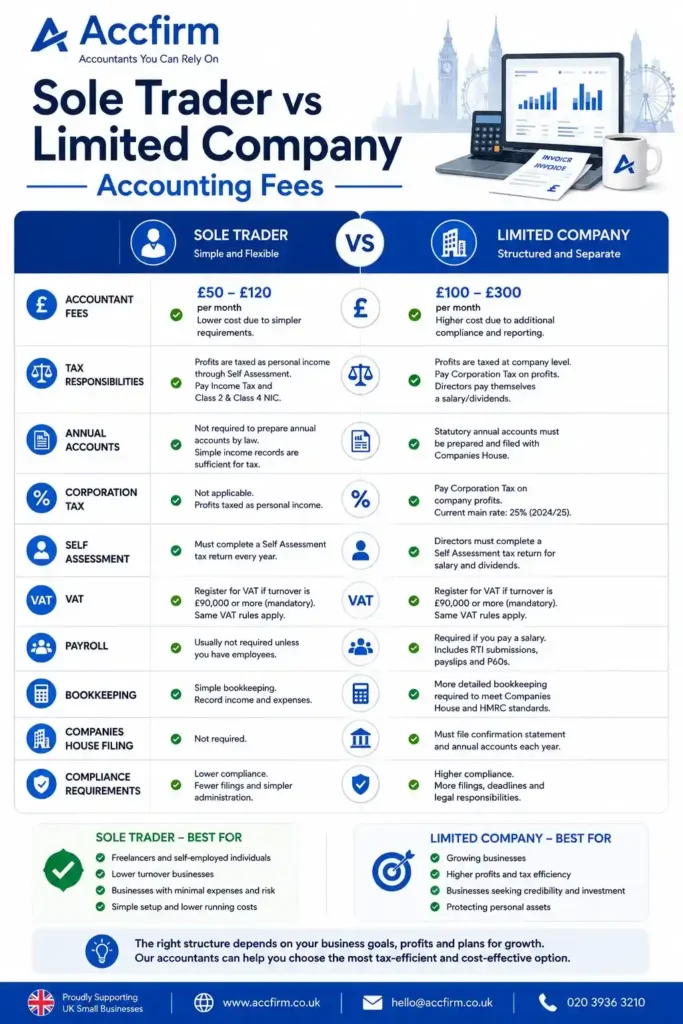
- Sole traders: £50–£120/month
- Freelancers: £60–£150/month
- Limited companies: £100–£300/month
- Annual accounts: £500–£2,000
- Self Assessment tax return: £150–£400
- Payroll: £10–£100/month
The exact price depends on your business size, turnover, number of employees, VAT registration, bookkeeping needs, payroll, and tax obligations.
Why Do Small Businesses Hire an Accountant?
Many business owners initially manage their own bookkeeping and tax returns. However, as a business grows, accounting responsibilities become more complex.
A qualified accountant can help with:
- Preparing annual accounts
- Filing Corporation Tax returns
- Completing Self Assessment tax returns
- Managing VAT returns
- Payroll processing
- Bookkeeping
- Financial reporting
- Tax planning
- Business growth advice
- HMRC compliance
Instead of spending valuable time on financial administration, business owners can focus on serving customers and growing their businesses.
How Much Does an Accountant Cost for a Small Business in the UK?
The cost of hiring an accountant varies considerably because every business has different accounting requirements.
Some businesses only need help submitting an annual tax return, while others require monthly bookkeeping, payroll, VAT returns, management accounts, and strategic financial advice.
Generally, UK accountants offer three pricing models:
- Fixed monthly packages
- One-off service fees
- Hourly rates
Many modern accounting firms now provide fixed monthly packages, making costs easier to budget throughout the year.

Average UK Accountant Fees
| Accounting Service | Typical UK Cost |
|---|---|
| Sole Trader Tax Return | £150–£350 |
| Self Assessment Return | £150–£400 |
| Annual Accounts | £500–£2,000 |
| Corporation Tax Return | £300–£900 |
| Bookkeeping | £50–£300/month |
| Payroll | £10–£100/month |
| VAT Returns | £50–£200 |
| Company Formation | £50–£300 |
| Management Accounts | £100–£500/month |
These figures are general estimates and can vary depending on your accountant, business complexity, and the services included.
Typical Monthly Accountant Fees
Many accountants now offer monthly subscription packages instead of charging separately for every service.
| Business Type | Average Monthly Fee |
|---|---|
| Sole Trader | £50–£120 |
| Freelancer | £60–£150 |
| Contractor | £75–£180 |
| Partnership | £100–£250 |
| Limited Company | £100–£300 |
| E-commerce Business | £150–£400 |
Monthly packages often include bookkeeping software, tax support, annual accounts, and unlimited email advice.
What Is Usually Included in Monthly Accounting Packages?
Although every accountant offers different packages, many include:
- Bookkeeping support
- Cloud accounting software
- VAT returns
- Payroll
- Corporation Tax returns
- Annual accounts
- Self Assessment (where applicable)
- Companies House filings
- HMRC submissions
- Business tax advice
- Email and telephone support
Some premium packages may also include cash flow forecasting, budgeting, management reports, and regular business review meetings.
One-Off Accountant Fees
If you only need occasional support, many accountants also charge fixed fees for individual services.
| One-Off Service | Average Fee |
|---|---|
| Register a Limited Company | £50–£300 |
| Self Assessment Tax Return | £150–£400 |
| Corporation Tax Return | £300–£900 |
| VAT Registration | £50–£150 |
| Payroll Setup | £50–£200 |
| Confirmation Statement | £50–£120 |
| Companies House Filing | £50–£150 |
These one-off services can be suitable for businesses that handle most day-to-day bookkeeping themselves.
What Determines the Cost of an Accountant?
No two businesses are identical, so accounting fees are rarely the same. Several factors influence how much you’ll pay.
1. Business Structure
Your legal structure has a significant impact on accounting costs.
For example:
- Sole traders generally have simpler tax obligations.
- Partnerships require partnership tax returns.
- Limited companies have additional responsibilities, including Corporation Tax, annual accounts, and Companies House filings.
As a result, limited companies typically pay higher accounting fees than sole traders.
2. Business Size
A business issuing a handful of invoices each month is much easier to manage than one processing hundreds of customer transactions.
Larger businesses often require:
- More bookkeeping
- More reconciliations
- Detailed management reports
- Additional tax planning
- Regular financial advice
More work usually means higher accounting fees.
3. Annual Turnover
Businesses with higher turnover generally have:
- More transactions
- Larger supplier networks
- Increased reporting requirements
- Greater tax responsibilities
An accountant will typically spend more time managing these businesses, which can increase costs.
4. VAT Registration
VAT registration adds extra responsibilities.
Your accountant may need to:
- Prepare VAT returns
- Check VAT invoices
- Review allowable VAT claims
- Submit returns through Making Tax Digital (MTD)-compatible software
- Resolve VAT queries with HMRC
Businesses registered for VAT usually pay more than businesses below the VAT registration threshold.
5. Payroll Requirements
If you employ staff, payroll becomes another important consideration.
Payroll services often include:
- PAYE calculations
- National Insurance deductions
- Pension submissions
- Payslips
- RTI submissions to HMRC
- Year-end payroll reporting
The more employees you have, the higher payroll administration costs are likely to be.
6. Bookkeeping Volume
One of the biggest pricing factors is bookkeeping.
If your accountant receives organised digital records each month, their work is usually straightforward.
However, businesses with:
- Missing receipts
- Paper invoices
- Unreconciled bank statements
- Poor record keeping
often require significantly more accounting time.
Maintaining accurate financial records throughout the year can help reduce accounting fees.
7. Accounting Software
Businesses using cloud accounting software such as Xero, QuickBooks, or Sage often benefit from faster bookkeeping and real-time collaboration with their accountant.
Cloud software can:
- Reduce manual data entry
- Improve accuracy
- Speed up bank reconciliation
- Simplify VAT submissions
- Provide real-time financial information
Because processes are more efficient, accountants may be able to offer better-value fixed monthly packages.
Expert Accountant Tip
Don’t choose an accountant based on price alone. A slightly higher monthly fee may include valuable services such as tax planning, unlimited support, cloud accounting software, and proactive advice that could save your business far more than the additional cost.
What Services Are Included in an Accountant’s Fees?
The services included in an accountant’s fees can vary depending on the package you choose. Some accountants offer basic compliance services, while others provide comprehensive business support throughout the year.
If you’re comparing quotes, don’t focus solely on the monthly price. Always check exactly what is included. A package that costs slightly more may offer additional services that save you both time and money.
Typical Services Included
Most UK accountants offer some or all of the following:
- Bookkeeping
- Annual accounts preparation
- Corporation Tax returns
- Self Assessment tax returns
- VAT registration and VAT returns
- Payroll processing
- PAYE administration
- Confirmation Statement filing
- Companies House submissions
- HMRC compliance support
- Cloud accounting software setup
- Financial reporting
- Business performance reviews
- Tax planning advice
- Unlimited email or telephone support (depending on the package)
For growing businesses, accountants may also provide forecasting, budgeting, cash flow planning, and strategic financial advice.
What Services Might Cost Extra?
Not every accounting task is covered by a standard monthly package.
Additional charges may apply for:
- Company formation
- Business plans
- Mortgage references
- Tax investigations
- HMRC enquiry support
- Capital Gains Tax advice
- R&D tax relief claims
- Business valuations
- Director remuneration planning
- Specialist tax advice
- International tax matters
Always ask for a detailed list of included and excluded services before signing an engagement letter.
Accountant Fees by Business Type
Different business structures have different legal and tax obligations, which directly affect accounting costs.
Sole Traders
Sole traders generally have the simplest accounting requirements.
Typical services include:
- Bookkeeping
- Self Assessment
- Business expense advice
- Income Tax calculations
- National Insurance calculations
Typical monthly fee: £50–£120
Suitable for:
- Freelancers
- Consultants
- Tradespeople
- Small local businesses
Freelancers
Freelancers usually need ongoing bookkeeping support alongside annual tax returns.
Typical services include:
- Expense tracking
- Self Assessment
- Tax planning
- Allowable expenses advice
- Cloud accounting software
Typical monthly fee: £60–£150
Contractors
Contractors often work through limited companies and have additional responsibilities.
Typical services include:
- Payroll
- Dividend planning
- Corporation Tax
- Annual accounts
- VAT
- Director tax advice
Typical monthly fee: £75–£180
Partnerships
Partnerships require both partnership tax returns and individual partner tax returns.
Services often include:
- Partnership accounts
- Partnership Tax Return
- Profit allocation
- Self Assessment for partners
Typical monthly fee: £100–£250
Limited Companies
Limited companies have the highest compliance requirements.
Most accountants will manage:
- Annual accounts
- Corporation Tax
- Companies House filing
- Payroll
- VAT
- Director salaries
- Dividend planning
- Confirmation Statement
Typical monthly fee: £100–£300
Larger companies with more employees and higher turnover may pay considerably more.
E-commerce Businesses
Online businesses often require additional accounting support because they deal with multiple payment platforms, inventory, and sometimes international sales.
An accountant may help with:
- Shopify accounting
- Amazon accounting
- eBay accounting
- Stripe reconciliation
- PayPal reconciliation
- Stock reporting
- VAT compliance
Typical monthly fee: £150–£400
Comparison Table: Accountant Costs by Business Type
| Business Type | Average Monthly Fee | Complexity |
|---|---|---|
| Sole Trader | £50–£120 | Low |
| Freelancer | £60–£150 | Low |
| Contractor | £75–£180 | Medium |
| Partnership | £100–£250 | Medium |
| Limited Company | £100–£300 | High |
| E-commerce Business | £150–£400 | High |
Monthly Accountant Fees vs One-Off Fees
Many business owners wonder whether it’s better to pay monthly or only when they need accounting support.
The right choice depends on your business needs.
| Monthly Accounting Package | One-Off Services |
|---|---|
| Predictable monthly cost | Pay only when needed |
| Year-round support | Limited support |
| Tax planning included | Usually no tax planning |
| Regular bookkeeping | DIY bookkeeping |
| Ongoing advice | Advice charged separately |
| Better cash flow management | May become expensive over time |
Monthly Packages Are Often Better For:
- Limited companies
- VAT-registered businesses
- Employers
- Growing businesses
- Startups
- Businesses using cloud accounting software
One-Off Services May Suit:
- Sole traders with simple finances
- Side businesses
- Businesses with very few transactions
- Individuals needing only a Self Assessment tax return

Online Accountant vs Traditional Accountant
Technology has changed how accounting services are delivered.
Many UK accountants now operate entirely online, allowing clients to upload documents digitally and receive advice remotely.
Online Accountant
Advantages
- Lower fees
- Cloud accounting software
- Digital document storage
- Faster communication
- Real-time reporting
- Secure online access
- Flexible appointments
Disadvantages
- Limited face-to-face meetings
- May feel less personal for some businesses
Traditional Local Accountant
Advantages
- Face-to-face meetings
- Local business knowledge
- Personal relationship
- Paper document handling if preferred
Disadvantages
- Often more expensive
- Office appointment required
- Less flexible communication
- Manual paperwork
Cost Comparison
| Accountant Type | Typical Monthly Fee |
|---|---|
| Online Accountant | £50–£200 |
| Local Accountant | £100–£350 |
Both options can provide excellent service. The best choice depends on your preferred way of working rather than price alone.
How Much Does an Accountant Cost for a Small Business Compared with Doing It Yourself?
Many entrepreneurs consider managing their own accounts to save money.
While DIY accounting can reduce short-term costs, it’s important to consider the bigger picture.
DIY Accounting Costs
Although you may not pay an accountant, you’ll likely still need:
- Accounting software subscription
- Time spent learning tax rules
- Time spent maintaining records
- Time preparing VAT returns
- Time filing tax returns
- Time resolving HMRC queries
Mistakes can also lead to penalties, interest charges, or missed tax-saving opportunities.
Hiring an Accountant
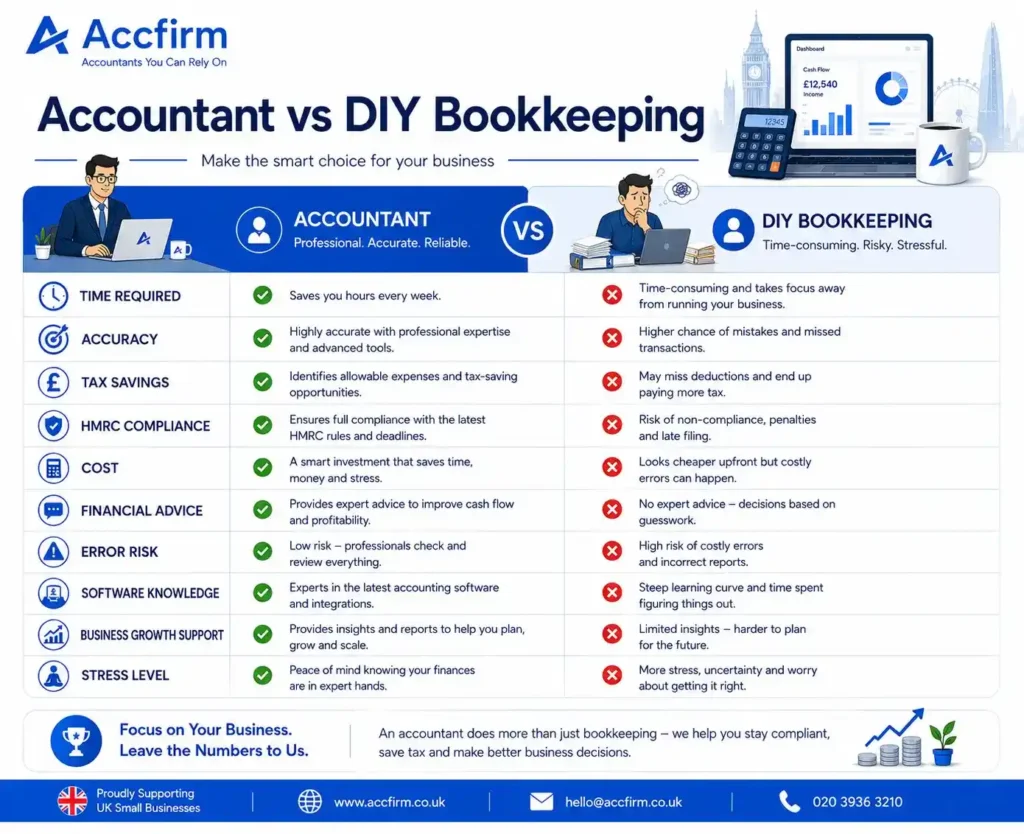
A professional accountant can:
- Identify allowable expenses
- Reduce tax liabilities legally
- Ensure deadlines are met
- Prepare accurate financial statements
- Submit returns correctly
- Represent you if HMRC raises queries
- Provide strategic business advice
For many business owners, the time saved alone outweighs the monthly accounting fee.
DIY vs Accountant Comparison
| DIY Accounting | Professional Accountant |
|---|---|
| Lower upfront cost | Monthly fee |
| Time-consuming | Saves significant time |
| Higher risk of mistakes | Professional accuracy |
| Limited tax knowledge | Expert tax planning |
| Must monitor deadlines | Accountant helps manage deadlines |
| Manual administration | Streamlined processes |
Is Hiring an Accountant Worth the Cost?
For most small businesses, the answer is yes.
An accountant does much more than prepare tax returns. They help keep your business compliant, identify tax-saving opportunities, and provide financial insights that support long-term growth.
Key Benefits of Hiring an Accountant
- Saves valuable time
- Reduces stress during tax season
- Minimises the risk of HMRC penalties
- Helps claim allowable expenses correctly
- Improves financial record keeping
- Supports business growth
- Provides cash flow insights
- Offers strategic financial advice
- Keeps your business compliant with changing tax rules
Real-Life Example
Imagine a limited company director who spends several evenings each month updating bookkeeping records, reconciling bank transactions, and preparing VAT returns.
By outsourcing these tasks to an accountant, the director can focus on winning new clients, improving services, and increasing revenue. In many cases, the additional income generated from this extra time more than covers the accountant’s fees.
Expert Accountant Tip
Ask potential accountants whether their monthly fee includes proactive tax planning. An accountant who regularly reviews your business throughout the year may identify legitimate tax-saving opportunities before deadlines arise, rather than simply preparing year-end accounts.
Common Mistakes to Avoid
Many small business owners make the following mistakes when choosing an accountant:
- Choosing solely based on the lowest price
- Not checking what services are included
- Ignoring software compatibility
- Waiting until tax deadlines to seek help
- Failing to compare fixed-fee packages
- Keeping poor financial records
- Not asking about response times or support availability
- Assuming every accountant specialises in all business sectors
Choosing an accountant based on expertise, transparency, and the value they provide is often more beneficial than focusing on cost alone.
How to Choose the Right Accountant for Your Small Business
Choosing an accountant isn’t just about finding the lowest price. The right accountant can become a trusted adviser who helps you stay compliant, improve profitability, and make informed financial decisions as your business grows.
Before making your decision, consider the following factors.
1. Check Their Qualifications
Look for accountants who are members of recognised UK professional bodies, such as:
- ICAEW
- ACCA
- CIMA
- AAT
Membership of a recognised body means the accountant follows professional standards and undertakes ongoing training.
2. Experience with Small Businesses
Every industry has unique accounting requirements. Choose an accountant who regularly works with businesses similar to yours, whether you’re a:
- Sole trader
- Limited company
- Contractor
- Landlord
- E-commerce seller
- Healthcare professional
- Startup
Relevant experience often leads to more practical advice and fewer compliance issues.
3. Transparent Pricing
Ask for a clear breakdown of fees before signing up.
Find out:
- What’s included in the monthly package?
- Are there additional charges?
- Is support unlimited?
- Are software licences included?
- Will fees increase as your business grows?
Transparent pricing helps avoid unexpected costs later.
4. Cloud Accounting Expertise
Many businesses now use cloud accounting software to automate bookkeeping and simplify financial management.
An accountant who works with cloud software can help you:
- Access real-time financial data
- Share documents securely
- Automate bank feeds
- Submit VAT returns efficiently
- Collaborate throughout the year
5. Communication and Support
Good accountants explain complex financial matters in plain English.
Before choosing one, ask:
- How quickly do you respond to emails?
- Will I have a dedicated accountant?
- Can I contact you throughout the year?
- Do you offer video meetings?
Regular communication is particularly valuable during periods of business growth.
Questions to Ask Before Hiring an Accountant
- Use this checklist during your first consultation.
- What services are included in your monthly fee?
- Do you work with businesses like mine?
- Can you support HMRC enquiries?
- Which accounting software do you recommend?
- Are there any setup fees?
- Do you offer tax planning?
- Will you remind me about important deadlines?
- Can you help with business growth as well as compliance?
- Is there a fixed contract?
- How will we communicate?
These questions can help you compare accountants based on value rather than price alone.
Ways to Reduce Your Accounting Costs
Hiring an accountant doesn’t have to be expensive. By keeping your financial records organised and working efficiently with your accountant, you may be able to reduce your overall accounting costs.
Keep Your Records Organised
Well-organised records save time.
Store:
- Receipts
- Purchase invoices
- Sales invoices
- Bank statements
- Payroll information
Digitally wherever possible.
Use Cloud Accounting Software
Cloud accounting software can automate many repetitive tasks, reducing manual work for both you and your accountant.
Benefits include:
- Automatic bank feeds
- Digital receipt capture
- Real-time reporting
- Faster bookkeeping
- Easier collaboration
Submit Information Promptly
Late paperwork often creates additional work.
Send your documents regularly rather than waiting until the end of the tax year.
Separate Business and Personal Finances
Using a dedicated business bank account makes bookkeeping simpler and helps reduce accounting time.
Ask About Fixed-Fee Packages
Many accountants offer better value through fixed monthly plans that include multiple services for one predictable price.
Accountant Cost Checklist
Before hiring an accountant, make sure you know:
- Your monthly budget
- Which services you need
- Whether you’re VAT registered
- Whether payroll is required
- Your preferred accounting software
- Your business structure
- Your annual turnover
- Your growth plans
Having this information ready will help an accountant provide a more accurate quotation.
Conclusion
Hiring an accountant is an investment in your business rather than simply another expense. While fees vary depending on your business structure, turnover, and the services you need, professional accounting support can save time, improve tax efficiency, and reduce the risk of costly mistakes.
If you’re still asking how much does an accountant cost for a small business, remember that the cheapest option isn’t always the best value. A knowledgeable accountant who understands your business can provide ongoing advice, help you meet your legal obligations, and support your long-term success.
Whether you’re a sole trader starting out or a growing limited company, choosing the right accountant can give you confidence that your finances are managed accurately and professionally.
- Most UK small businesses pay £50–£300 per month for accounting services.
- Sole traders generally pay less than limited companies.
- Fixed monthly packages offer predictable costs and ongoing support.
- Fees depend on business size, turnover, payroll, bookkeeping, and VAT obligations.
- Choosing an accountant based on expertise and service quality often provides better long-term value than choosing the lowest price.
- Cloud accounting software can improve efficiency and reduce administration.
- Professional accounting advice can help businesses stay compliant and make informed financial decisions.
How much does an accountant cost for a small business?
In the UK, a small business typically pays £50 to £300 per month for accounting services. Sole traders usually pay lower fees, while limited companies with payroll, VAT, and bookkeeping requirements generally pay more. Costs depend on the complexity of the business and the services included.
Frequently Asked Questions (FAQs)
1. How much does an accountant cost for a small business in the UK?
Most small businesses pay between £50 and £300 per month, depending on the services required and the complexity of the business.
2. Is hiring an accountant worth it for a small business?
Yes. An accountant can save you time, help reduce tax liabilities within the law, improve compliance, and provide financial advice that supports business growth.
3. Do sole traders need an accountant?
It’s not a legal requirement, but many sole traders choose to use an accountant for tax returns, bookkeeping, and financial guidance.
4. How much does a Self Assessment tax return cost?
A straightforward Self Assessment tax return generally costs between £150 and £400, although fees can vary depending on complexity.
5. What is included in a monthly accounting package?
Typical packages may include bookkeeping, annual accounts, tax returns, VAT returns, payroll support, Companies House filings, and general accounting advice.
6. Are online accountants cheaper?
In many cases, yes. Online accountants often have lower overheads and may offer more competitive fixed-fee packages than traditional firms.
7. Can an accountant save my business money?
A good accountant may identify legitimate tax-saving opportunities, improve cash flow management, and help avoid costly errors or penalties.
8. Should I choose the cheapest accountant?
Not necessarily. Consider experience, qualifications, service quality, communication, and what’s included in the fee.
9. How often should I meet my accountant?
This depends on your business needs. Many businesses benefit from regular quarterly reviews, while others may only require annual meetings alongside ongoing email or phone support.
10. Can my accountant deal with HMRC on my behalf?
Yes. With your authorisation, an accountant can communicate with HMRC, submit returns, and help resolve tax queries.
11. Does bookkeeping cost extra?
Some accountants include bookkeeping in their monthly package, while others charge separately. Always check what’s included before signing up.
12. How much does payroll cost?
Payroll services generally range from £10 to £100 per month, depending on the number of employees and payroll complexity.
13. Is cloud accounting better than spreadsheets?
Cloud accounting software offers automated bank feeds, real-time reporting, secure document storage, and easier collaboration, making it a popular choice for many small businesses.
14. Can an accountant help a new startup?
Yes. Accountants can assist with business registration, choosing the right structure, tax planning, bookkeeping systems, and ongoing financial advice.
15. What should I prepare before meeting an accountant?
Bring details of your business structure, turnover, expenses, existing financial records, tax history, and any questions about your accounting or tax obligations.
Final Call to Action
Every business is different, and so are its accounting needs. Rather than choosing an accountant based solely on price, consider the expertise, services, and ongoing support they provide. Investing in professional advice can help you stay compliant, make informed financial decisions, and focus on growing your business. If you’re still wondering how much does an accountant cost for a small business, speaking with a qualified accountant about your specific requirements is the best way to receive an accurate quotation and tailored guidance.